Yungang Grottoes
5A 景区云冈石窟 · Yúngāng Shíkū
China's earliest great imperial cave temples — 5th-century sandstone grottoes near Datong with 252 caves and over 51,000 statues.
Don't want to go alone? Post on the board and find a travel buddy.
Find a buddyOverview
Carved into a sandstone ridge west of Datong, Yungang is where China's monumental Buddhist cave art begins. Created mainly between 460 and 525 CE under the Northern Wei, it preserves 252 caves and more than 51,000 statues, the largest some 17 metres tall. Where Longmen shows Buddhism becoming Chinese, Yungang catches it just after arrival — still glowing with Indian, Central Asian, Persian and even Greek-derived forms carried east along the Silk Road.
History
After an earlier emperor's brutal suppression of Buddhism, the Northern Wei court made amends on a colossal scale. Around 460 CE the monk-official Tanyao directed the first five great caves (today's caves 16–20), each enshrining a giant Buddha said to embody one of the five Northern Wei emperors — making the carvings a statement of both faith and dynastic power. Work continued until the capital moved to Luoyang in 494 CE, after which energy shifted to Longmen. Yungang's caves 5–6 and 9–13, added a little later, are the most richly decorated.
Culture & religion
Buddhism reached China along the Silk Road about 2,000 years ago and became deeply Chinese. It teaches release from life’s suffering through compassion, mindfulness and meditation — and inspired most of China’s great temples, grottoes and pagodas.
Yungang is the Silk Road written in stone. The faces, drapery, lions, acanthus leaves and musical instruments mix Gandhara (Indo-Greek), Indian and Central Asian models with emerging Chinese taste — a vivid record of how a foreign religion and its art entered China. Politically it embodies the Northern Wei idea of the emperor as a Buddha on earth, a fusion of spiritual and imperial authority that sat in tension with Confucian officials and Daoist rivals at court. To stand before Cave 20's open-air Buddha is to see the precise moment Buddhist art set down on Chinese soil.
What to see
Cave 20 — the open-air seated Buddha
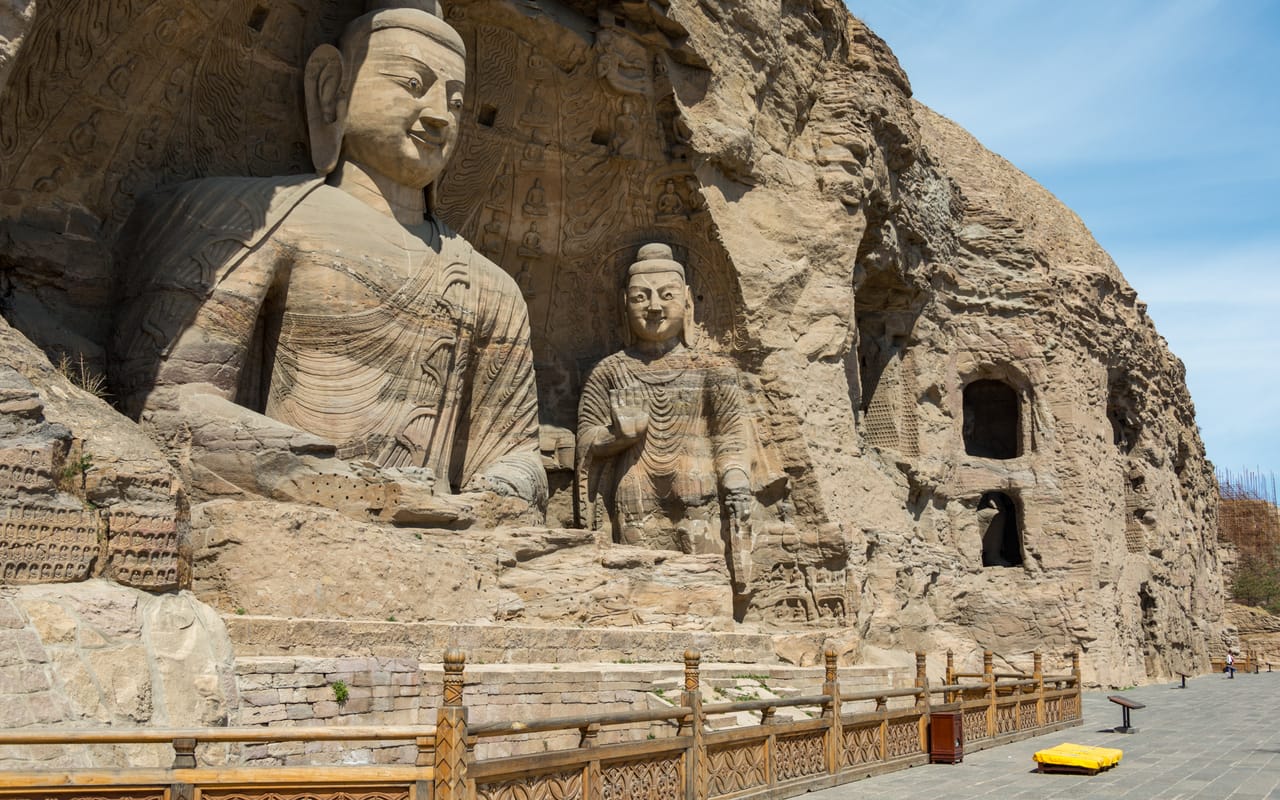
Yungang's icon: a 13.7 m seated Buddha whose front wall collapsed long ago, leaving it serenely exposed to the sky. The broad shoulders and faint smile show strong Central Asian influence.
The Tanyao Five (Caves 16–20)
The original five colossal caves, each a giant Buddha linked to a Northern Wei emperor — the founding statement of the whole site.
Caves 5 & 6 — the ornate pair
Cave 5 holds a 17 m seated Buddha; Cave 6 is a dazzling carved chamber with a central pagoda-pillar narrating the life of the Buddha in relief.
Caves 9–13 — the 'colourful caves'
Later caves retaining vivid pigment, with flying apsaras, musicians and a riot of decorative detail.
Visiting
Allow 2–3 hours; the site is fairly compact and walkable. Sandstone is fragile and light inside caves is dim — photography of interiors is often restricted. Spring to autumn is most comfortable; Datong winters are bitterly cold.
- Tickets
- Around ¥120 in peak season, less in winter (approximate — confirm officially). The ticket includes the landscaped approach and on-site museum.
- Opening hours
- Roughly 08:30–17:30 in summer and 08:30–17:00 in winter, last entry about an hour before closing. Seasonal variation applies.
- Suggested route
- A roughly linear 1.5–2.5 km walk: the ceremonial approach and Lingyan Temple → the main cave sequence (caves 1–20) along the cliff → on-site museum, returning to the entrance. Half a day including travel from Datong.
Suggested routes
1. Main walking route
About 2–2.5 hours~1.5 kmFrom the ceremonial approach through caves 1–20 along the cliff, then the museum. Compact and mostly flat.
2. Short highlights route
About 1–1.5 hours~1 kmIf you're short on time, focus on the Tanyao Five (caves 16–20) and the ornate caves 5–6.
Points of interest
- 🛕
Tanyao Five Caves · 昙曜五窟
Caves 16–20, the founding colossi.
- 🛕
Cave 20 — open-air Buddha · 第20窟
The icon of Yungang.
- 🛕
Caves 5 & 6 · 第5、6窟
The most ornate, with a carved pagoda-pillar.
- ⛩️
Lingyan Temple · 灵岩寺
Reconstructed temple on the approach lake.
- 🏛️
Yungang Museum · 云冈石窟博物馆
Context before or after the caves.
- 🎫
Visitor center · 游客中心
Tickets and the walk in.
Getting there
About 16 km west of Datong. City bus 3 runs directly to the grottoes; a taxi/DiDi takes ~30 minutes. Datong is on the high-speed-rail network (~1.5–2 h from Beijing).