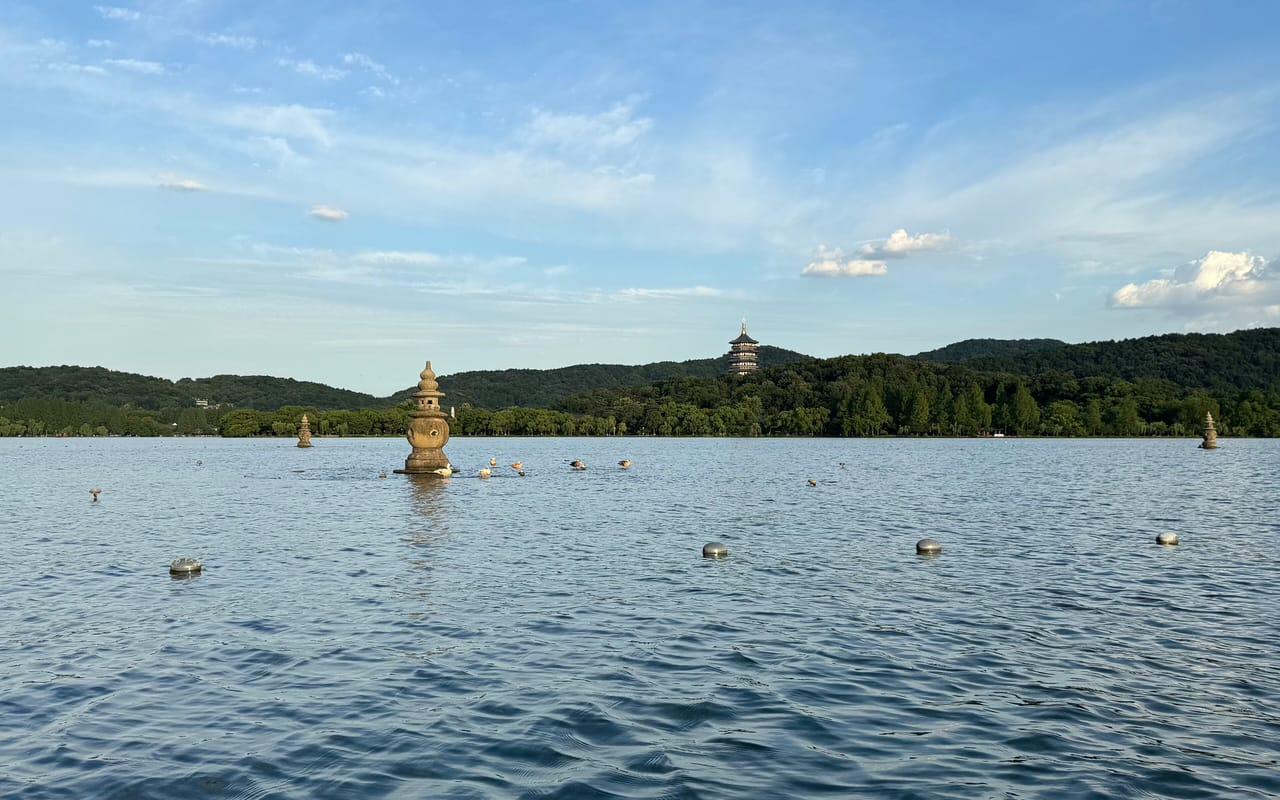
West Lake
5A 景区西湖 · Xī Hú
The classic Chinese landscape lake — pagodas, causeways, willows and tea hills that shaped a thousand years of poetry and painting.
Don't want to go alone? Post on the board and find a travel buddy.
Find a buddyOverview
West Lake is the lake every Chinese painter has in mind: about 6.4 km² of calm water ringed by green hills, threaded by tree-lined causeways and dotted with islands and pagodas. UNESCO-listed in 2011 for its influence on garden design across Asia, it is free to wander and best taken slowly, on foot, by bike or by boat.
History
The lake was shaped as much by people as by nature. Two of China's greatest poet-officials engineered it: Bai Juyi in the Tang and Su Dongpo in the Song dredged the lake and built the Bai and Su causeways that still carry strollers today. Generations distilled its beauty into the famous 'Ten Scenes of West Lake'.
Culture & religion
West Lake is the textbook of Chinese landscape aesthetics — the harmony of nature and human design, composed views and 'borrowed' hills, beloved of the scholar-gentry ideal. It carries layers of legend and faith too: the Buddhist Lingyin Temple in the hills, and the tragic love story of the White Snake set at the Broken Bridge and Leifeng Pagoda. So many places copied it that 'West Lake' became a landscape archetype.
What to see
Su Causeway (苏堤)
Su Dongpo's 2.8 km willow-and-peach causeway across the lake, with six arched bridges — the classic walk, magic at dawn.
Leifeng Pagoda (雷峰塔)
A hilltop pagoda with sweeping lake views and the legend of the White Snake; glorious at sunset.
Lingyin Temple (灵隐寺)
One of China's great Buddhist temples, set among carved grottoes in the wooded hills behind the lake.
Three Pools Mirroring the Moon (三潭印月)
The island and its little stone pagodas in the water — the scene on the ¥1 note.
Visiting
The lakeside is free and open; you only pay for some sites and boats. Walk or rent a bike; take a boat to the islands. Dawn and dusk are loveliest; holidays are extremely crowded. A half to full day.
- Tickets
- Lakeside walking is free. Leifeng Pagoda ~¥40, Lingyin Temple ~¥45 (plus ~¥30 for the inner Feilai Feng), boats ~¥55 (approximate — confirm officially).
- Opening hours
- The lake area is open 24h; ticketed sites run roughly 07:30–17:30. Seasonal variation applies.
- Suggested route
- Broken Bridge → Bai Causeway → Gushan Island → Su Causeway → Leifeng Pagoda, with an optional boat to Three Pools Island. ~6–8 km on foot or by bike.
Suggested routes
1. Causeway walk/bike
About 3–4 hours~7 kmBroken Bridge → Bai Causeway → Su Causeway → Leifeng Pagoda. The classic lap; rent a bike to do it easily.
2. Lake + Lingyin Temple
About a full daylake walk + busAdd the Buddhist Lingyin Temple and Feilai Feng grottoes in the hills behind the lake.
Points of interest
- 1
Broken Bridge · 断桥
Start of the Bai Causeway; White Snake legend.
- 2
Su Causeway · 苏堤
Su Dongpo's willow causeway.
- 3
Leifeng Pagoda · 雷峰塔
Sunset views over the lake.
- 4
Three Pools Mirroring the Moon · 三潭印月
Island on the ¥1 note (by boat).
- 5
Lingyin Temple · 灵隐寺
Great Buddhist temple in the hills.
Getting there
Central Hangzhou. Subway Line 1 to Longxiangqiao, then a short walk to the lake. Hangzhou has high-speed rail and an airport.