Terracotta Army
5A 景区兵马俑 · Bīngmǎyǒng
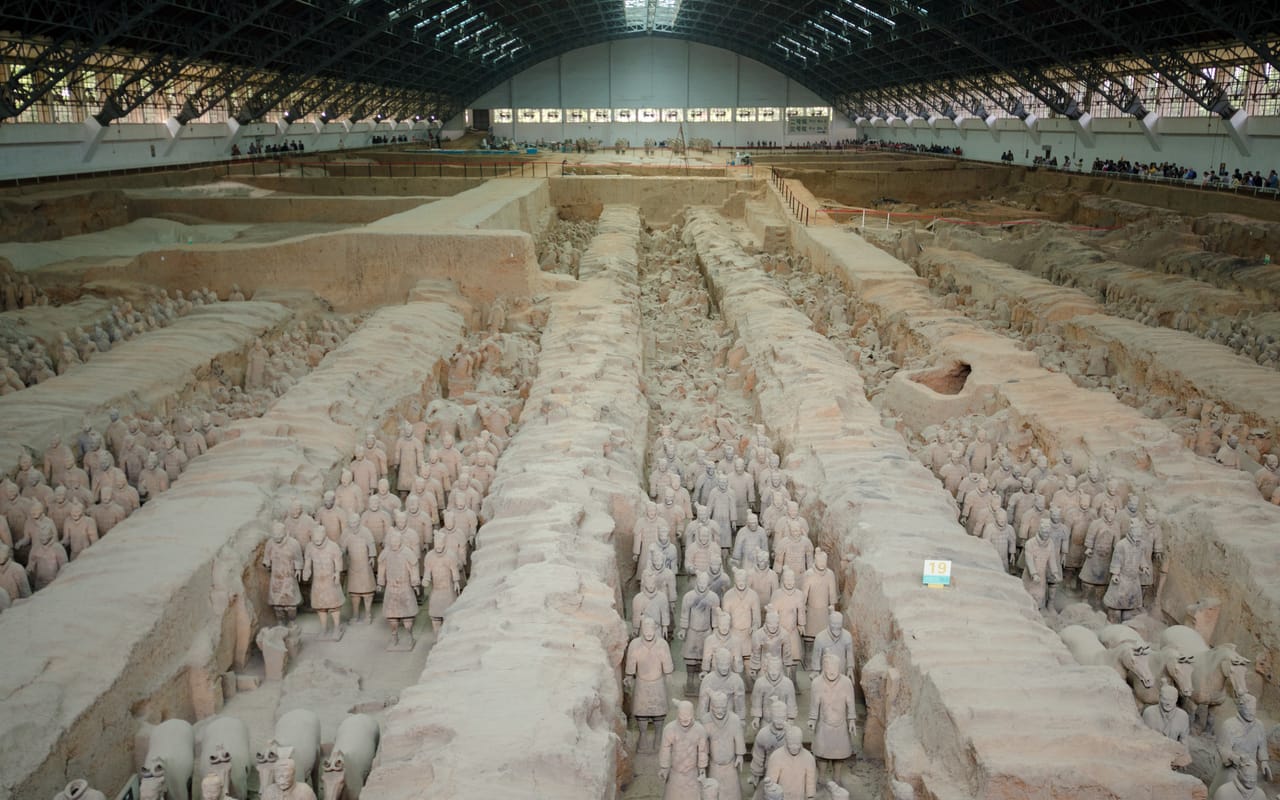
The 8,000-strong clay army guarding China's first emperor — one of the greatest archaeological discoveries of the 20th century.
Don't want to go alone? Post on the board and find a travel buddy.
Find a buddyOverview
Part of the colossal mausoleum of Qin Shi Huang, the first emperor of a unified China, the Terracotta Army is an underground host of roughly 8,000 life-size soldiers, plus horses and chariots, buried around 210 BCE to guard the emperor in the afterlife. Found by farmers digging a well in 1974, it is displayed over three excavation pits and a museum, and was inscribed by UNESCO in 1987.
History
Qin Shi Huang unified the warring states into one empire in 221 BCE and began an enormous tomb complex near his capital. Some 700,000 labourers worked on it. The terracotta warriors stand in pits about 1.5 km east of the still-unexcavated burial mound, facing east as if to defend against the conquered states. Forgotten for over two millennia, they were rediscovered in 1974 and are still being excavated and restored today.
Culture & religion
The army is a window into the Qin moment that made 'China'. Qin Shi Huang standardised the script, coinage, weights and axle-widths and imposed a Legalist, centralised state — power embodied in this disciplined clay host. Every soldier's face is individually modelled. The whole project also reflects the era's beliefs about death and the Daoist-tinged obsession with immortality: ancient texts describe the emperor's tomb as a model empire with rivers of mercury, a court continued underground.
What to see
Pit 1
The vast main pit — long columns of infantry in battle formation under a hangar-like hall. The signature view.
Pit 2
Cavalry, chariots and kneeling archers; some of the finest individual figures are displayed up close here.
Pit 3
The smallest pit, interpreted as the army's command post.
The Bronze Chariots
Two exquisite half-size bronze chariots with intricate harnesses — masterpieces of Qin metalwork, shown in the museum.
Visiting
It gets extremely crowded — arrive at opening or late afternoon. A guide or audio guide makes a huge difference, as the figures need context. Allow about 3 hours; you can combine it with Huaqing Palace and the emperor's tomb mound nearby.
- Tickets
- Around ¥120 (approximate — confirm officially), covering the three pits, the bronze-chariot hall and, via shuttle, the mausoleum mound site.
- Opening hours
- Roughly 08:30–17:00 (slightly longer in peak season), last entry about an hour before closing. Seasonal variation applies.
- Suggested route
- Most people go Pit 1 (the showpiece) → Pit 3 → Pit 2 → the Bronze Chariot exhibition → museum, then the shuttle to the tomb mound if time allows. ~2–3 hours in the pits.
Suggested routes
1. The three pits + chariots
About 2.5–3 hours~2 kmPit 1 → Pit 3 → Pit 2 → Bronze Chariot hall → museum. The complete museum visit.
2. Pits + the emperor's tomb mound
About half a dayshuttle + walkingAdd the free shuttle to the Lishan tomb mound ~1.5 km away — the actual (unexcavated) burial of the First Emperor.
Points of interest
- 1
Entrance & shuttle · 入口/摆渡车
Tickets, guides and the shuttle to the tomb mound.
- 2
Pit 1 · 一号坑
The huge main infantry array — the must-see.
- 3
Pit 2 · 二号坑
Cavalry and archers; finest close-up figures.
- 4
Pit 3 · 三号坑
The command post.
- 5
Bronze Chariots hall · 铜车马展厅
The two masterpiece bronze chariots.
Getting there
About 40 km east of Xi'an in Lintong. The tourist bus 游5 (306) runs from near Xi'an Railway Station in ~1 hour; a DiDi/taxi is faster. Xi'an has both high-speed rail and an airport.