Mogao Caves
莫高窟 · Mògāo Kū
The 'Caves of a Thousand Buddhas' near Dunhuang — a millennium of Silk Road murals and painted sculpture across 735 caves.
Don't want to go alone? Post on the board and find a travel buddy.
Find a buddyOverview
At a desert oasis where the Silk Road split around the Taklamakan, the Mogao Caves hold the world's richest treasury of Buddhist cave art. Begun in 366 CE and added to for almost a thousand years, the 735 caves preserve about 45,000 square metres of murals and more than 2,400 painted clay sculptures. Unlike Longmen and Yungang, Mogao's art is mostly painted, not carved — luminous walls of Buddhas, paradises, donors and the famous flying apsaras.
History
A wandering monk who saw a vision of a thousand Buddhas cut the first cave in 366 CE. As Dunhuang thrived as a Silk Road gateway, merchants, monks and officials funded caves for a millennium — through the Tang golden age and on to the Yuan. In 1900 a caretaker monk discovered a sealed chamber (Cave 17, the 'Library Cave') packed with around 50,000 manuscripts, paintings and textiles sealed since the 11th century. Foreign explorers carried much of it abroad in the following years; the study of these documents became the global field of 'Dunhuang studies'.
Culture & religion
Buddhism reached China along the Silk Road about 2,000 years ago and became deeply Chinese. It teaches release from life’s suffering through compassion, mindfulness and meditation — and inspired most of China’s great temples, grottoes and pagodas.
Mogao is a thousand-year crossroads of cultures and creeds. Its art fuses Indian, Central Asian, Persian and Chinese styles, tracing how Buddhism matured in China across dynasties. Above all it is a Buddhist site — vast paradise scenes, Jataka tales and devotional portraits — but the Library Cave also yielded Daoist scriptures and texts of Manichaeism and Nestorian Christianity, proof that this oasis hosted many faiths trading along the same road. Donor portraits and dedications again weave Confucian family and social values into Buddhist merit, showing the three teachings coexisting in everyday Chinese life.
What to see
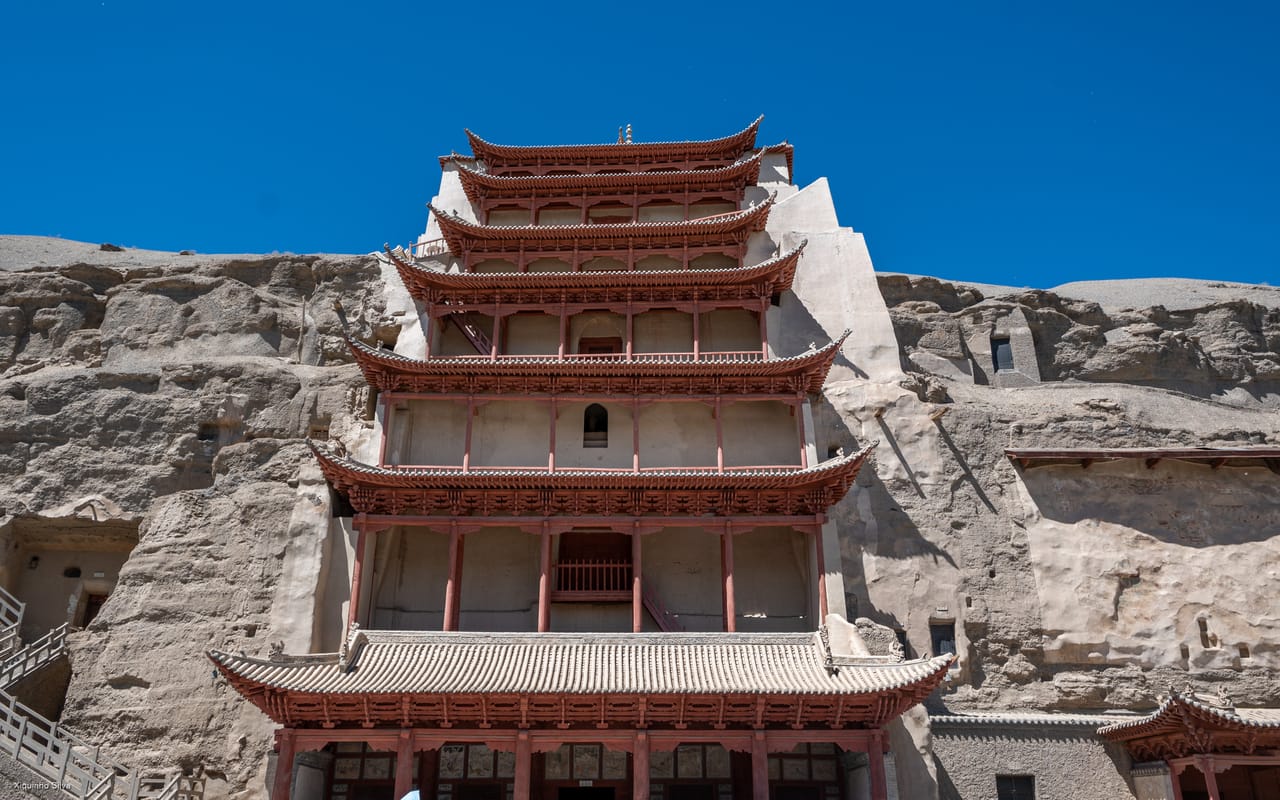
Cave 96 — the Nine-Storey Pagoda (九层楼)
The site's landmark wooden façade shelters a 35.5 m seated Maitreya Buddha from the Tang dynasty, one of the largest indoor statues in China.
Cave 17 — the Library Cave (藏经洞)
The small chamber whose ~50,000 sealed manuscripts rewrote our knowledge of medieval Asia — and whose dispersal abroad remains a poignant story.
Cave 148 — the Reclining Buddha
A serene 15 m reclining Buddha entering nirvana, ringed by mourning disciples in vivid Tang colour.
The flying apsaras (飞天)
Mogao's signature image: weightless celestial musicians and dancers trailing ribbons across the ceilings — the emblem of Dunhuang art.
Visiting
Visits are tightly managed to protect the murals. You must book ahead through the official reservation system; entry is by timed slot with a guide, daily numbers are capped, and photography inside the caves is forbidden. You first watch two films at the Digital Exhibition Center, then take a shuttle to the caves and tour a rotating set (about 8). Plan a half day.
- Tickets
- A full ('A') ticket is roughly ¥238 in peak season and includes the films, shuttle and ~8 caves; cheaper 'emergency' tickets show fewer caves. Winter/low-season pricing differs. Book early on the official site — slots sell out (approximate prices; confirm officially).
- Opening hours
- Roughly 09:00–17:00 (last sessions earlier), with reduced low-season operation in winter. Driven by reservation slots rather than walk-in hours.
- Suggested route
- Itinerary is fixed: Digital Exhibition Center films (~40 min) → ~15 min shuttle → guided cave tour (~1.5–2 h, ~8 caves) → return shuttle. Half a day end to end.
Suggested routes
1. Standard guided visit (A ticket)
About 3–4 hoursshuttle + walkingTwo films at the Digital Center → shuttle → a guided tour of about 8 caves. The full experience; book ahead.
2. Economy / emergency ticket
About 1.5–2 hoursshuttle + walkingFewer caves (often 4) and no films — for peak days when A tickets sell out. Reserve on the official site.
Points of interest
- 🎫
Digital Exhibition Center · 数字展示中心
Watch the two films first; the shuttle departs here.
- 🛕
Cave 96 — Nine-Storey Pagoda · 第96窟 九层楼
The 35.5 m Tang Buddha; the site's landmark.
- 🛕
Cave 17 — Library Cave · 第17窟 藏经洞
Where ~50,000 manuscripts were found.
- 🛕
Cave 148 — Reclining Buddha · 第148窟
A serene 15 m reclining Buddha.
- 🏛️
Dunhuang Academy museum · 敦煌研究院
Conservation and history of the caves.
Getting there
About 25 km southeast of Dunhuang. From the Digital Exhibition Center (near town) an official shuttle takes you to the caves. Dunhuang has its own airport and a high-speed-rail station.