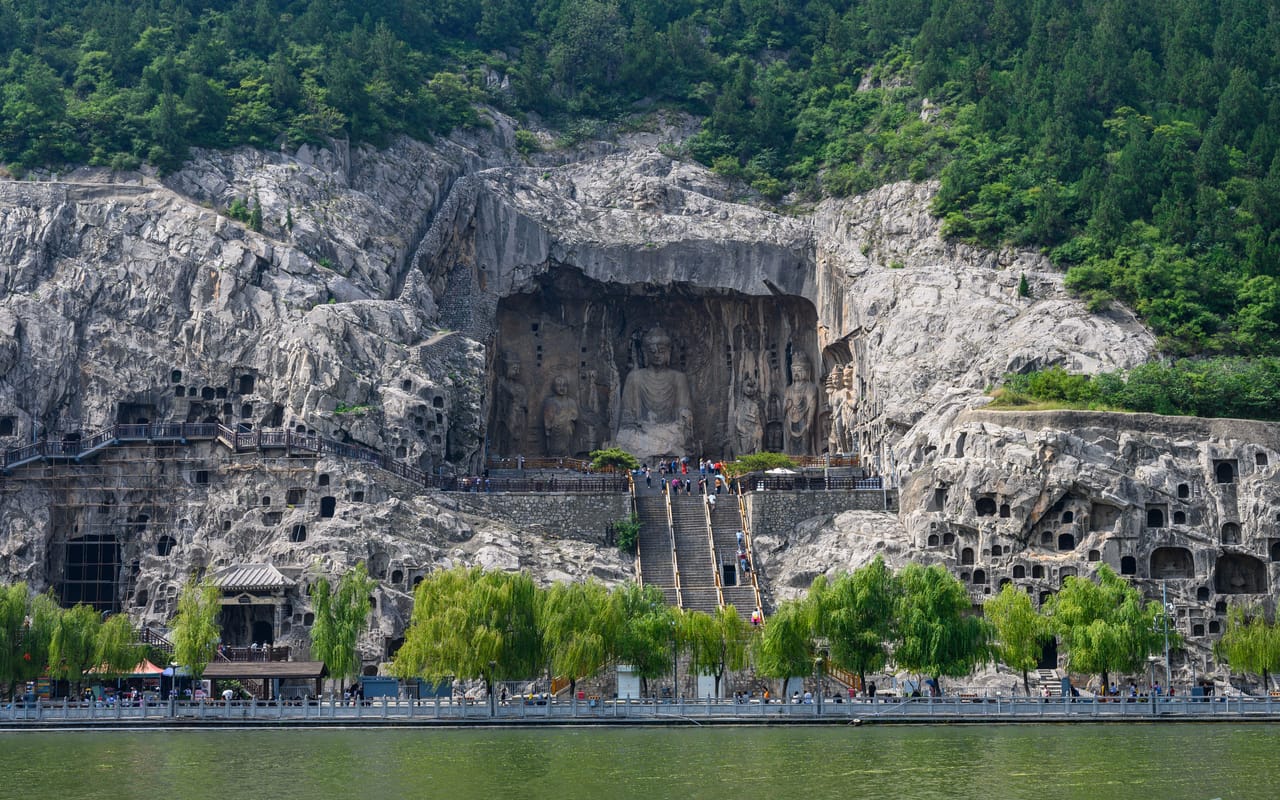
Longmen Grottoes
5A 景区龙门石窟 · Lóngmén Shíkū
A UNESCO-listed canyon of more than 2,300 caves and 100,000 Buddhist statues carved into limestone cliffs over four centuries.
Don't want to go alone? Post on the board and find a travel buddy.
Find a buddyOverview
Longmen ("Dragon Gate") is one of China's three great Buddhist cave complexes, cut into the cliffs on both banks of the Yi River just south of Luoyang. Across roughly 2,345 caves and niches you'll find over 100,000 statues — from a few centimetres to more than 17 metres tall — plus some 2,800 inscriptions and 60-odd pagodas. Carving began in 493 CE and continued for over 400 years, capturing the moment Buddhist art stopped imitating India and became fully Chinese.
History
Work started when the Northern Wei dynasty moved its capital from Datong (near Yungang) to Luoyang in 493 CE — the same rulers, a new sacred mountain. The Northern Wei caves (e.g. the Binyang caves and Guyang cave) show slender, ethereal, otherworldly figures. The complex peaked under the Tang dynasty (7th–8th c.), whose statues are fuller, rounder and more humane — none more famous than the Fengxian Temple colossus, completed in 675 CE with patronage from Empress Wu Zetian. Later dynasties added little; war, weathering and looting (many heads are now in foreign museums) took their toll, but the scale remains overwhelming.
Culture & religion
Buddhism reached China along the Silk Road about 2,000 years ago and became deeply Chinese. It teaches release from life’s suffering through compassion, mindfulness and meditation — and inspired most of China’s great temples, grottoes and pagodas.
Longmen is a stone timeline of Buddhism becoming Chinese. Buddhism arrived from India along the Silk Road and at first sat awkwardly beside China's native traditions — Confucianism (the state's ethical and social order) and Daoism (its mystical, nature-rooted counter-current). Emperors alternately sponsored and persecuted the foreign faith; the rival pull of Daoism and Confucian objections to monks leaving family and field fuelled several anti-Buddhist purges. Yet here Buddhism won imperial embrace: rulers presented themselves almost as living Buddhas, and donors' inscriptions blend Buddhist merit-making with deeply Confucian language about filial piety and loyalty. The shift from the austere Northern Wei style to the warm, confident Tang style mirrors a faith that had put down Chinese roots.
What to see
Fengxian Temple & the Vairocana Buddha (奉先寺)
The 17.14 m seated Vairocana Buddha is Longmen's masterpiece — a serene Tang face often said to echo Empress Wu Zetian, flanked by disciples, bodhisattvas and fierce guardian kings.
Binyang Caves (宾阳三洞)
Three Northern Wei caves; the central one took 24 years and shows the elongated, spiritual early style. Famous relief panels of imperial processions were stolen in the 1930s.
Ten Thousand Buddhas Cave (万佛洞)
A Tang cave lined with about 15,000 tiny Buddhas carved in relief, plus exquisite musicians and dancers around the walls.
Guyang Cave (古阳洞)
The oldest cave, treasured by calligraphers for the 'Twenty Masterworks of Longmen' — benchmark examples of Wei-style stone inscription.
Across the river: Xiangshan Temple & Bai Garden
The east bank holds Xiangshan Temple and the tomb-garden of Tang poet Bai Juyi, who loved this view — a quieter, leafy counterpoint to the carvings.
Visiting
Allow 3–4 hours. The main carvings line the West Hill; cross the bridge for the East Hill, Xiangshan Temple and Bai Garden. Go early to beat both crowds and midday glare on the west-facing cliff.
- Tickets
- Around ¥90 for the through-ticket covering all four areas (approximate — confirm on the official site). Buy with your passport; an electric cart along the riverside is a small extra fee.
- Opening hours
- Roughly 08:00–18:00 in summer and 08:00–17:00 in winter, with last entry about an hour before closing. Hours shift seasonally.
- Suggested route
- Typical loop ~2.5–3.5 km on foot: West Hill caves (north → south) → cross the Yi River bridge → East Hill viewpoint → Xiangshan Temple → Bai Garden, exiting at the south gate. Half a day total including travel from the city.
Suggested routes
1. Full walking route
About 3–3.5 hours~4 kmWalk both banks the whole way — saves the ~¥15 electric-cart fee and lets you pause at every cave.
2. Walking + electric cart
About 3 hours~4 kmRide the riverside cart (~¥15) between the gate and the West Hill caves to save your legs, then explore on foot.
3. Step-free / accessible route
About 2.5 hours~3 kmUses the cart and flatter riverside paths; some upper niches have stairs and are not step-free.
Points of interest
- 1
Visitor center · 游客中心
Buy tickets with your passport.
- 2
Binyang Caves · 宾阳三洞
Northern Wei masterworks.
- 3
Ten Thousand Buddhas Cave · 万佛洞
About 15,000 tiny Buddhas in relief.
- 4
Fengxian Temple · 奉先寺
The Vairocana Buddha — the must-see.
- 5
Yi River bridge · 伊河桥
Cross here to the East Hill.
- 6
Xiangshan Temple · 香山寺
Hillside temple beloved by the poet Bai Juyi.
- 7
Bai Garden · 白园
Quiet tomb-garden of Tang poet Bai Juyi.
Getting there
About 13 km south of central Luoyang. Bus 60/71/81 runs from the city; a DiDi/taxi takes ~30 minutes. Luoyang Longmen high-speed-rail station is ~10 minutes away by car.