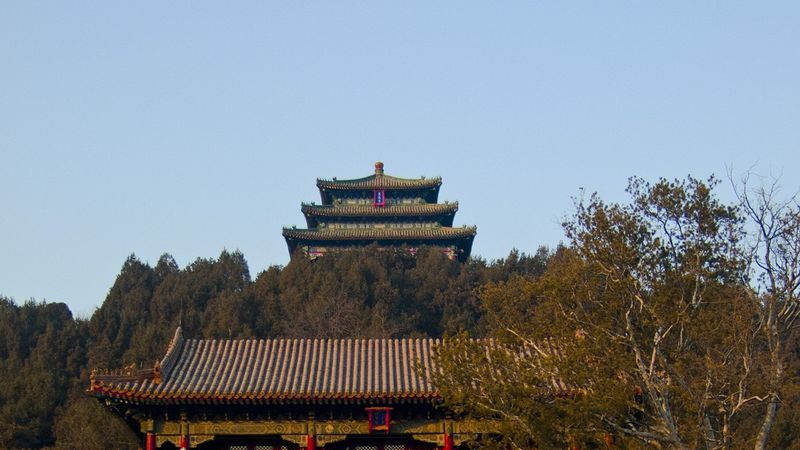
Jingshan Park
景山公园 · Jǐngshān Gōngyuán
The artificial hill directly behind the Forbidden City, crowned by a pavilion with the definitive panorama over the golden palace roofs and Beijing's central axis.
Don't want to go alone? Post on the board and find a travel buddy.
Find a buddyOverview
Jingshan ("Prospect Hill") is a landscaped park built around a 45-metre artificial hill immediately north of the Forbidden City. Climb the short path to the Wanchun Pavilion at the summit and you get the classic view: the whole sweep of golden palace roofs to the south and Beijing's ruler-straight central axis running north to the Drum and Bell Towers. It is the perfect finish to a Forbidden City visit.
History
The hill was raised in the early 1400s from earth excavated for the Forbidden City's moat, part of the Ming reshaping of the capital along its grand axis. It served as an imperial garden and, by feng-shui logic, as a "protective" screen shielding the palace from the north. The five pavilions along its ridge were added under the Qing. The site is also remembered as where the last Ming emperor, Chongzhen, took his life in 1644 as rebels entered the city.
Culture & religion
Jingshan is the best place to grasp how Beijing was designed: a single ceremonial axis, with the Forbidden City at its heart and the hill as its deliberate northern anchor. Traditional Chinese city-planning and feng shui favoured a hill to the north at one's back; here it was built on purpose. From the summit the axis reads like a diagram of imperial order — which is exactly why it is the photograph everyone wants of the palace.
What to see
Wanchun Pavilion (万春亭)
The hilltop pavilion at the summit — the panoramic viewpoint over the Forbidden City.
The central-axis view
Golden palace roofs to the south, the Drum and Bell Towers due north — Beijing's plan laid out at a glance.
The five ridge pavilions
Qing-era pavilions strung along the crest, each once holding a bronze Buddha.
Locals at leisure
Morning singing groups, dancing and calligraphy on the ground with water-brushes — everyday Beijing life.
Visiting
Come right after the Forbidden City — its north exit (Gate of Divine Might) is directly across the street from Jingshan's south gate. The climb to the top is short but steep with steps; go near sunset for warm light on the roofs. Allow 1–1.5 hours.
- Tickets
- Entrance is a token fee, around ¥2 (approximate — confirm on the official park site). Cash-free payment via WeChat/Alipay at the gate.
- Opening hours
- Roughly 06:30–20:00 or 21:00 in summer and shorter in winter, with last entry before closing. Seasonal variation applies.
- Suggested route
- Enter the south gate → climb the stepped path to the Wanchun Pavilion at the summit for the palace panorama → descend the north side toward the Drum and Bell Towers or the Shichahai lakes. ~1 km, about an hour.
Suggested routes
1. Summit view (quick)
About 1 hour~1 kmStraight up to the Wanchun Pavilion for the classic Forbidden City panorama and back down.
2. Palace-to-park finish
About 1.5 hours~1.5 kmCross from the Forbidden City's north exit, climb for the sunset view, then walk on to Shichahai.
Points of interest
- 1
South gate · 南门
Across from the Forbidden City's north exit.
- 2
Wanchun Pavilion (summit) · 万春亭
The panoramic hilltop viewpoint.
- 3
North gate · 北门
Exit toward the Drum and Bell Towers.
Getting there
Directly north of the Forbidden City on Beijing's central axis. Subway Line 8 to Shichahai or Nanluoguxiang, then a short walk; or simply cross the road from the Forbidden City's north exit. Buses stop on Jingshan Front Street.