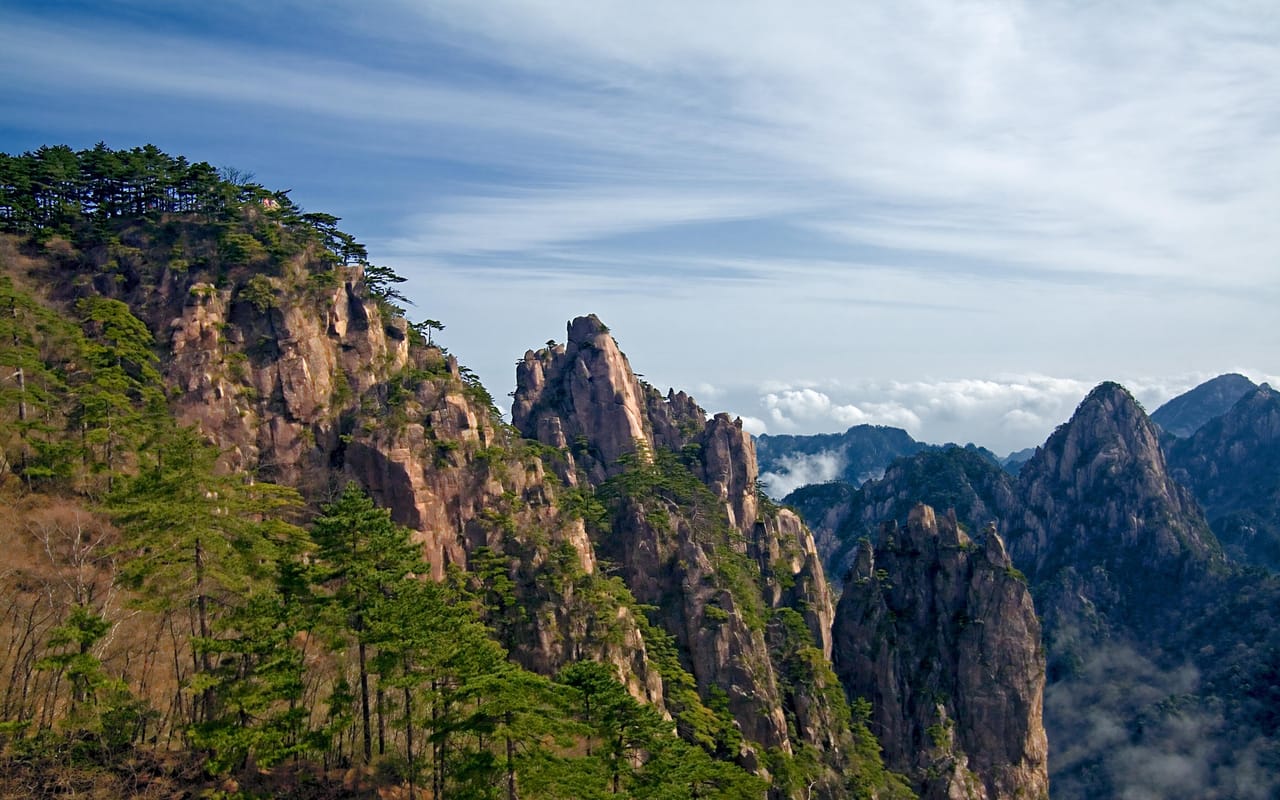
Huangshan (Yellow Mountain)
5A 景区黄山 · Huáng Shān
The 'Yellow Mountain' of legend — granite peaks, twisted pines and seas of cloud that defined Chinese landscape art.
Don't want to go alone? Post on the board and find a travel buddy.
Find a buddyOverview
Huangshan is the mountain that taught China how to see mountains. A UNESCO site since 1990, its granite peaks — Lotus, Bright Summit, Celestial Capital — rise above valleys that fill with rolling seas of cloud. It is famous for its 'four wonders': fantastically shaped pines, grotesque rocks, the cloud seas, and hot springs. Cable cars and summit hotels let you stay for sunrise.
History
Sacred and celebrated since the Tang dynasty — it was renamed Huangshan in 747 CE after the legendary Yellow Emperor — the mountain became the great muse of Chinese landscape painting and gave its name to the influential 'Huangshan school' of artists. Modern cable cars opened its once-arduous heights to everyone.
Culture & religion
Huangshan is the archetype behind a whole art tradition: 'you needn't see other mountains after Huangshan', the old saying goes. Its mist, pine and stone are the very vocabulary of shan-shui painting and poetry, and it carries Daoist associations of the immortals. Waiting in the cold dawn for the cloud sea to catch the sunrise is, for many Chinese, almost a pilgrimage.
What to see
Sea of Clouds (云海)
On the right mornings the valleys fill with cloud and the peaks become islands — Huangshan's signature sight.
Welcoming-Guests Pine (迎客松)
The ancient, gnarled pine with one arm outstretched in greeting — a national emblem of hospitality.
Bright Summit Peak (光明顶)
One of the highest points and a prime spot for sunrise and the cloud sea.
Celestial Capital & Lotus Peaks
The most dramatic granite summits, reached by vertiginous stone stairways carved into the rock.
Visiting
Plan 1–2 days and, ideally, stay overnight on the summit for sunrise. Take a cable car up to save a long climb; bring warm layers (it's cold and windy up top) and good shoes for the steep stairs. The cloud sea depends entirely on weather.
- Tickets
- Mountain entrance around ¥190; each cable car is ~¥80–90 one way (approximate — confirm officially). Summit hotels are pricey and book out — reserve ahead.
- Opening hours
- The mountain and cable cars run roughly 06:00–17:30; cable-car queues can be long in peak season. Seasonal variation applies.
- Suggested route
- Yungu cable car up → Beihai / Bright Summit area → overnight at a summit hotel → sunrise at a viewpoint → Welcoming-Guests Pine and the Jade Screen area → cable car or hike down. One night on the mountain is ideal.
Suggested routes
1. Two-day classic (sunrise)
2 days / 1 nightcable car + walkingCable car up, walk the summit trails, overnight on top, catch the sunrise cloud sea, then descend. The ideal way.
2. One-day highlights
About 1 long daycable car + walkingCable car up and down, hit Bright Summit and the Welcoming-Guests Pine. Doable but rushed and you miss sunrise.
Points of interest
- 1
Yungu cable car base · 云谷索道
Common way up the east side.
- 2
Welcoming-Guests Pine · 迎客松
The famous greeting pine.
- 3
Bright Summit Peak · 光明顶
Top viewpoint & sunrise.
- 4
Lotus Peak · 莲花峰
The highest summit.
- 5
Beihai sunrise viewpoint · 北海日出
Classic cloud-sea sunrise spot.
Getting there
Huangshan City (Tunxi) has an airport and high-speed rail; from there a bus reaches Tangkou at the mountain's foot, then shuttles to the Yungu or Mercy Light cable-car bases.