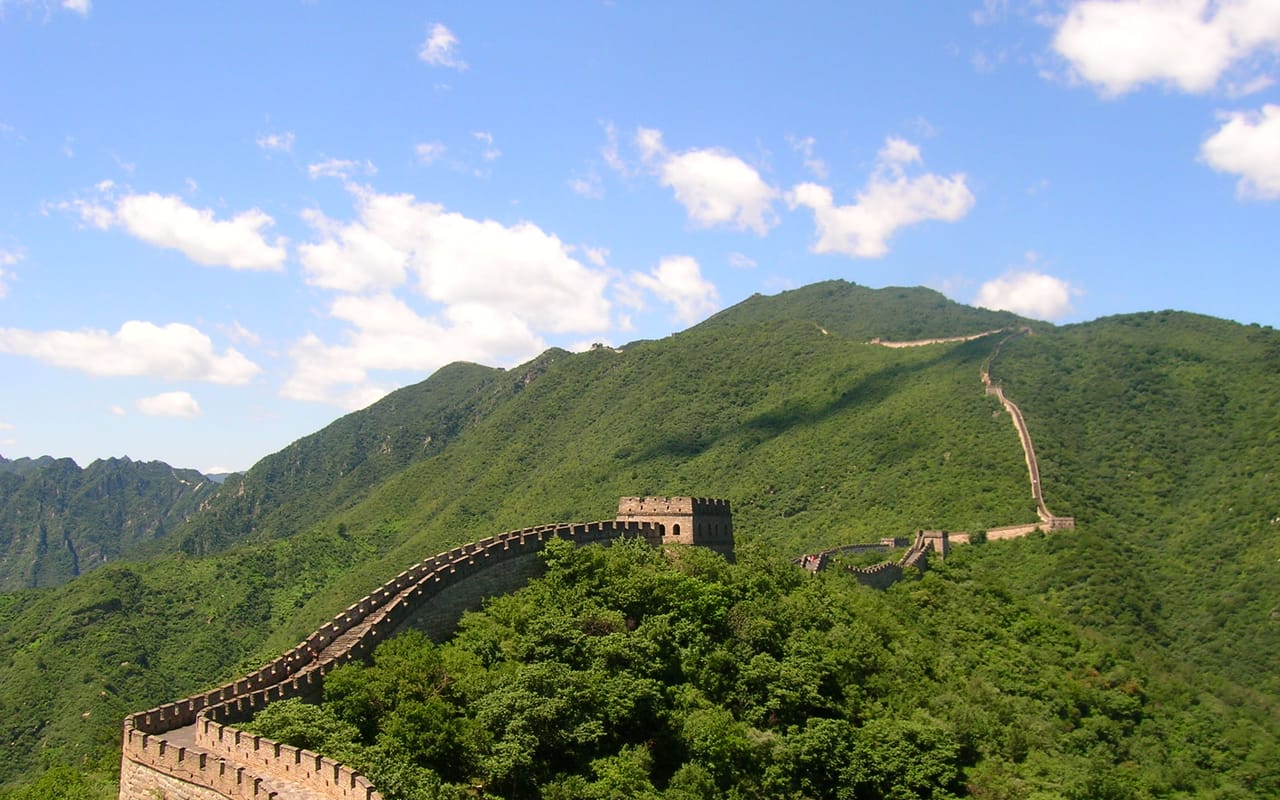
Great Wall (Mutianyu)
5A 景区慕田峪长城 · Mùtiányù Chángchéng
A beautifully restored, less-crowded stretch of the Great Wall about 70 km northeast of Beijing — forest, ramparts and 22 watchtowers.
Don't want to go alone? Post on the board and find a travel buddy.
Find a buddyOverview
Mutianyu is one of the best-preserved and most scenic restored sections of the Great Wall, with about 2.25 km open to visitors and 22 watchtowers along a forested ridge. A cable car and chairlift carry you up, and a toboggan run brings you down. It trades the crowds of Badaling for room to breathe and sweeping mountain views.
History
The Great Wall is not one wall but many, built and rebuilt over more than 2,000 years. Qin Shi Huang linked earlier state walls around 220 BCE; what most visitors see today, including Mutianyu, is the stone-and-brick wall of the Ming dynasty (14th–17th c.). The Mutianyu section was built up under the Ming general Xu Da to guard the northern approaches to the capital.
Culture & religion
The Wall was always more than a barrier. It marked the long frontier between settled, agrarian China and the nomadic herding peoples of the steppe — a line of identity as much as defence. Its repeated rebuilding tracks how each dynasty defined and protected 'China', and its unification under Qin Shi Huang made it an enduring symbol of the nation pulled into one. Walking it, you feel the sheer scale of a civilisation's effort to hold a boundary across mountains.
What to see
Cable car & chairlift
The easiest way up to the wall; the chairlift drops you near the scenic central towers.
The toboggan descent
A metal slide that runs down the mountainside — a fun, fast way back to the base.
Watchtowers 14–23
The best-restored, most photogenic stretch, with battlements winding over forested ridges.
The Ox Horn Edge
A dramatic section where the wall doubles back steeply along the ridgeline.
Visiting
Go on a weekday morning to avoid crowds and haze. The popular combo is cable car up and toboggan down. Wear proper shoes — the wall is steep and uneven in places. Allow 3–4 hours including travel up and down.
- Tickets
- Entrance around ¥45; the cable car / chairlift / toboggan are separate (~¥120–140 round trip) and a shuttle bus runs from the ticket office to the wall base (approximate — confirm officially).
- Opening hours
- Roughly 07:30–18:00 in summer and 08:00–17:00 in winter; the lifts close earlier. Seasonal variation applies.
- Suggested route
- Shuttle from the ticket office to the wall base → cable car or chairlift up (or hike the stairs) → walk the towers (14 → 23 is the classic stretch) → toboggan or cable car back down. Half a day from the city.
Suggested routes
1. Cable car up + toboggan down (easy)
About 3 hours~2.5 km on the wallThe relaxed classic: ride up, walk the best towers, slide down. Best for most visitors.
2. Hike up and back (active)
About 4–5 hours~5 kmClimb the stone stairs from the base, walk the full open section and back. Steep — bring water and good shoes.
Points of interest
- 1
Ticket office & shuttle · 售票处/摆渡车
Buy tickets and catch the shuttle to the wall base.
- 2
Cable car station · 缆车站
Cable car / chairlift up to the central towers.
- 3
Tower 14 viewpoint · 14号敌楼
A favourite vantage over the ridgeline.
- 4
Tower 20 viewpoint · 20号敌楼
Sweeping views along the restored wall.
- 5
Toboggan start · 滑道
The slide back down to the base.
Getting there
About 70 km northeast of Beijing with no fast public transport — the easy options are a hired car or a small-group day trip (~1.5–2 h each way). Budget route: bus 916 express to Huairou, then a local bus or taxi.