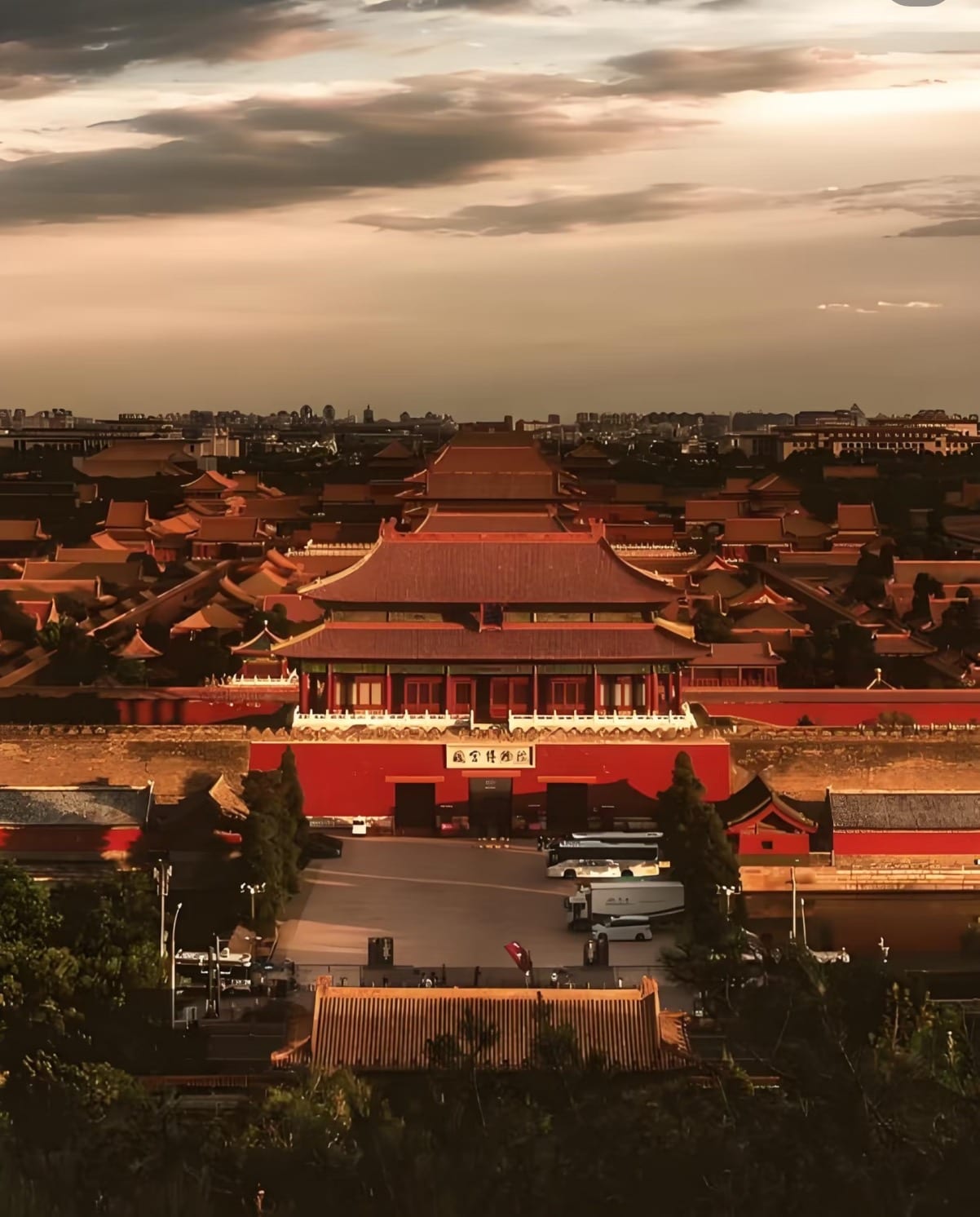
故宫 · Gùgōng
The vast imperial palace at the heart of Beijing — home to 24 Ming and Qing emperors over five centuries, now the Palace Museum.
Don't want to go alone? Post on the board and find a travel buddy.
Find a buddyOverview
The Forbidden City is the largest surviving palace complex on earth: roughly 72 hectares, around 980 surviving buildings, ringed by a 52-metre moat and 10-metre walls. Built from 1406 to 1420 and the seat of imperial power until 1912, it became the Palace Museum in 1925 and was inscribed by UNESCO in 1987. You walk it from south to north along a single ceremonial axis.
History
The Yongle Emperor of the Ming built it when he moved the capital to Beijing, completing it in 1420. Twenty-four emperors of the Ming and then the Qing ruled from here until the last emperor, Puyi, abdicated in 1912; he lived on in the rear palaces until 1924. Commoners were forbidden to enter — hence the name. It opened to the public as a museum in 1925.
Culture & religion
The Forbidden City is Confucian cosmology built in timber and tile. Its rigid south–north symmetry, the rising sequence of gates and halls, and the emperor's throne on the central axis all express the idea of the ruler as the Son of Heaven — the pivot between heaven and earth and the apex of a hierarchical, ordered society. Yellow roof tiles were reserved for the emperor; numbers (especially nine) and feng-shui orientation govern the layout. It is less a home than a stage for the cosmic role of the throne.
What to see
Meridian Gate (午门)
The monumental south entrance where emperors reviewed troops and issued the calendar.
Hall of Supreme Harmony (太和殿)
The largest wooden hall in China, holding the Dragon Throne — used for coronations and the grandest ceremonies.
The Three Great Halls
Supreme Harmony, Central Harmony and Preserving Harmony, raised on a triple marble terrace — the ceremonial core of the empire.
Imperial Garden (御花园)
A compact garden of ancient cypresses, rockeries and pavilions at the north end, where the court relaxed.
Treasure & Clock Galleries
In the eastern palaces: imperial jade, gold and an astonishing collection of elaborate mechanical clocks.
Visiting
Book online days ahead with your passport — daily tickets cap out and sell. Entry is one-way: in at the Meridian Gate (south), out at the Gate of Divine Might (north). Closed Mondays. Allow about 3 hours; the central axis is the must, the side palaces reward more time.
- Tickets
- Around ¥60 in peak season (Apr–Oct) and ¥40 in low season; the Treasure Gallery and Clock Gallery are small extra fees (approximate — confirm on the official Palace Museum site).
- Opening hours
- Roughly 08:30–17:00 in summer and 08:30–16:30 in winter, last entry about an hour before. Closed Mondays (except some holidays).
- Suggested route
- Enter Meridian Gate → the Three Great Halls up the central axis → the Inner Court palaces → Imperial Garden → exit the Gate of Divine Might (north), right by Jingshan Park's hilltop view back over the golden roofs. ~2–3 km, half a day.
Photos & photographers
Roaming photographers wander the grounds offering to snap your photo — a fun, cheap way to get a beautiful shot at this iconic spot without handing your phone to a stranger.
- Expect around ¥20 per photo. You can bargain, and ask for a trial shot (试拍) first — agree the price and how many photos before they start.
- Getting the photos is instant: most carry a USB-C card reader they plug straight into your phone to copy the originals on the spot — no WeChat or account needed (they can also send by QR code if you prefer).
- Pay by Alipay or WeChat once you have the photos. Just settle the number of shots and the price up front to avoid surprises.
Prefer a pre-arranged, English-speaking photographer for a proper photo shoot? We can help you find one — tell us the place, date and time, and we’ll match a photographer and confirm by email.
Request a photographerSuggested routes
1. Central axis (classic)
About 2.5–3 hours~2.5 kmStraight up the ceremonial axis through the Three Great Halls to the Imperial Garden and out north. The essential route.
2. Axis + eastern galleries
About 4 hours~3.5 kmAdd the Treasure Gallery and Clock Gallery in the eastern palaces for jade, gold and the famous mechanical clocks.
Points of interest
- 1
Meridian Gate (entrance) · 午门
The only public entrance, on the south.
- 2
Hall of Supreme Harmony · 太和殿
The Dragon Throne and the grandest hall.
- 3
Inner Court palaces · 后三宫
Where the emperor and family actually lived.
- 4
Imperial Garden · 御花园
Ancient cypresses and pavilions at the north.
- 5
Gate of Divine Might (exit) · 神武门
North exit, by Jingshan Park.
Getting there
In central Beijing. Take Subway Line 1 to Tian'anmen East or Tian'anmen West, then walk north through Tian'anmen to the Meridian Gate. You cannot enter from the north.