Dazu Rock Carvings
5A 景区💎 Hidden gem大足石刻 · Dàzú Shíkè
A UNESCO World Heritage collection of exquisite cliff carvings (9th–13th c.) that fuse Buddhism, Daoism and Confucianism.
Don't want to go alone? Post on the board and find a travel buddy.
Find a buddyOverview
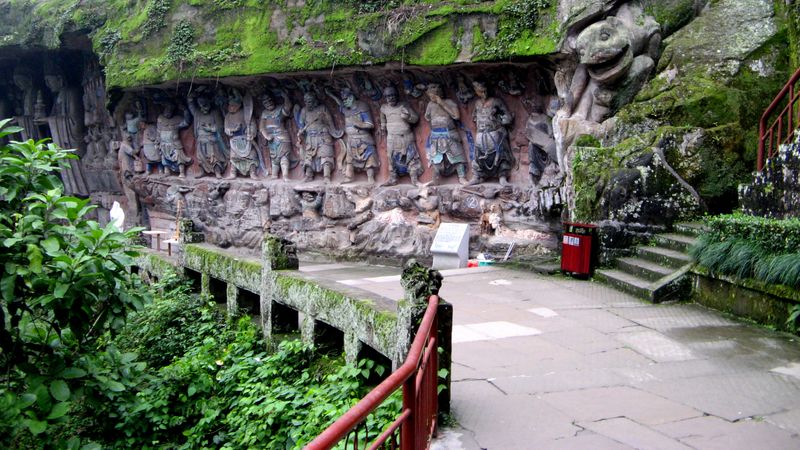
The Dazu Rock Carvings are tens of thousands of religious sculptures spread across several hillsides in Dazu, west of Chongqing. The finest cluster, on Baoding Mountain, is a single great composition of vivid, narrative scenes carved into a horseshoe cliff; the carvings on Beishan are older and more intricate. Together they mark the high point — and effectively the last great flowering — of Chinese cliff sculpture.
History
Carving began in the late Tang dynasty (9th century) and reached its peak from the Song dynasty (10th–13th centuries). The Baoding Mountain grottoes were conceived in the 12th century by the monk Zhao Zhifeng as a single, planned Tantric-Buddhist programme carved over some seventy years. After the great northern grottoes (Yungang, Longmen) had declined, Dazu carried the tradition to a new, more humane and storytelling-driven climax. It was inscribed as a World Heritage site in 1999.
Culture & religion
Many Chinese sites blend Buddhism, Daoism and Confucianism side by side — the “Three Teachings” (三教). Rather than one exclusive faith, Chinese tradition often weaves all three together.
Dazu is the best place in China to see the 'three teachings' — Buddhism, Daoism and Confucianism — carved side by side, reflecting how thoroughly they had merged in popular religion by the Song. The scenes are strikingly down-to-earth: parables about filial duty, drunkenness, herding and family life, rendered with humour and tenderness. Where Longmen overwhelms with scale, Dazu draws you in with narrative and human detail.
What to see
Baoding Mountain (宝顶山)
A horseshoe cliff of interconnected scenes planned as one composition — the must-see cluster.
Reclining Buddha (卧佛)
A serene 31-metre carving of the Buddha entering nirvana, only the upper body shown.
Wheel of Life (六道轮回)
A powerful depiction of the Buddhist cycle of rebirth clutched in the jaws of impermanence.
Beishan carvings (北山)
Older, smaller and more delicate niches, famous for graceful bodhisattvas.
Visiting
Most visitors focus on Baoding Mountain, the richest single site; add Beishan if you have time. An audio guide or guide really helps, as the carvings tell stories. Allow most of a day including travel.
- Tickets
- Baoding Mountain is roughly ¥115 and Beishan ¥70, with combination tickets available (approximate — confirm officially).
- Opening hours
- Generally about 08:30–17:30; last entry earlier.
- Suggested route
- Dazu town → Baoding Mountain (walk the horseshoe cliff: Reclining Buddha, Wheel of Life, the parable scenes) → optional Beishan niches. Allow a full day.
Suggested routes
1. Baoding Mountain highlights
Half a daycliff walkWalk the horseshoe cliff past the Reclining Buddha, the Wheel of Life and the parable scenes.
2. Dazu in a day
1 daytwo sitesAdd the older, more delicate Beishan niches for the full picture.
Points of interest
- 1
Baoding Mountain entrance · 宝顶山
The main carving cluster.
- 2
Reclining Buddha · 卧佛
31-metre nirvana carving.
- 3
Wheel of Life · 六道轮回图
Cycle of rebirth relief.
- 4
Beishan carvings · 北山石刻
Older, delicate niches.
Getting there
From Chongqing, take a train or bus to Dazu (about 1.5–2 hours), then a local bus or taxi to Baoding Mountain. Day tours from Chongqing are common.